
The Open Government Partnership (OGP) aims to promote transparency and accountability in governance so that citizens can better participate in public decision-making. As a member of the OGP Steering Committee in the Philippines, the Institute provides advisory support on the development and direction of OGP in the country.

What is OGP?
In 2011, the OGP was established as a worldwide effort to encourage government and non-government stakeholders to promote transparency and citizen empowerment. In addition, the OGP advocates anti-corruption efforts and the use of technology to strengthen governance.
OGP is an international platform where member governments commit to implement national programs that:
Fosters transparency and accountability in governance;
Promotes citizens’ participation in public decision-making; and
Leverages information and communications technology for citizen participation
Which countries are involved?
The Philippines is one of the 8 founding countries of the OGP along with the following: Brazil, Indonesia, Mexico, Norway, South Africa, the United Kingdom and the United States. As of 2017, there are a total of 75 participating countries.

OGP IN THE PHILIPPINES
National Action Plans
As of 2017, the Philippine government has published 4 OGP National Action Plans (NAP). The first NAP was established in 2012 with 20 open government initiatives. In 2013, the second NAP was released with 9 commitments and in 2015, the third NAP included 12 commitments. The 4th NAP from 2017 contains 12 commitments, 5 of which have been continued from the previous NAP and 7 new commitments. Click the links below to access the Philippines' NAPs.
PH-OGP National Action Plan 2013-2015
PH-OGP National Action Plan 2012
PH-OGP Steering Committee
The OGP Steering Committee of the Philippines sets the direction of OGP efforts for the country. It consists of representatives from government and non-government organizations such as the following:
Department of Budget and Management
Department of Social Welfare and Development
Department of the Interior and Local Government
Office of the Cabinet Secretary
National Economic and Development Authority
House of Representatives
Senate
Private sector
Academe
Civil society organizations
The OGP Steering Committee is comprised 50% by government and 50% non-government representatives. DLSU-JRIG sits on this committee as a representative of academe.
MAKING ALL VOICES COUNT
The Program
Making All Voices Count is "a global initiative that supports innovation, scaling-up, and research to deepen existing innovations and help harness new technologies to enable citizen engagement and government responsiveness."
"It is about seizing this moment to promote transparency, fight corruption, empower citizens, and harness the power of new technologies to make government more effective and accountable."
Universities and Knowledge Partnerships for Open Government
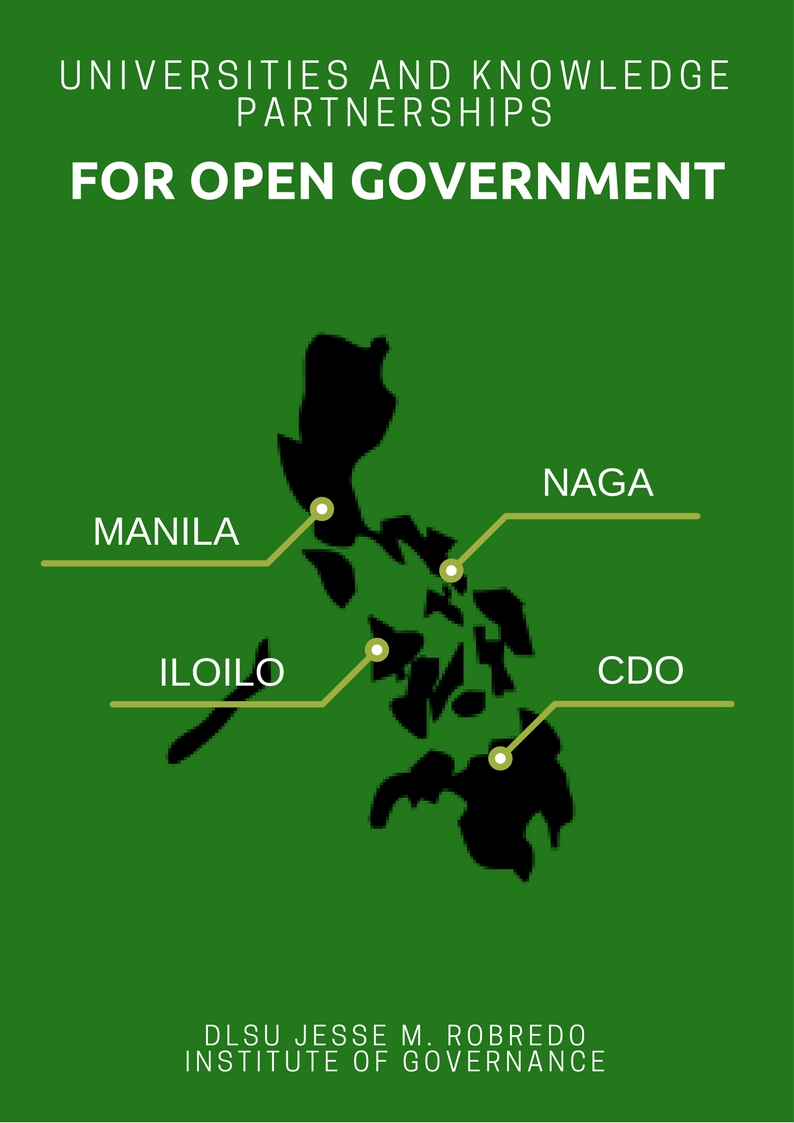
In 2016, DLSU-JRIG was awarded a grant under the MAVC program to implement the Universities and Knowledge Partnerships for Open Government project. Its purpose is to capacitate local universities so that they are able to serve as effective infomediaries on the use of open government data. Accomplishing this would allow universities to improve their civil society engagement and promote social accountability.
Our change goal
Universities will operate as regional knowledge hubs that influence stakeholders to promote evidence-based OGP reforms at both the local and national level.
OUR UNIVERSITY PARTNERS
Our partners for this project are strategically located throughout the three major island groups of the Philippines:

CENTER FOR LOCAL GOVERNANCE
Ateneo de Naga University Luzon - Naga City

CENTER FOR LOCAL GOVERNANCE AND INDIGENOUS PEOPLE STUDIES
Central Philippine University Visayas - IloIlo City

GOVERNANCE AND LEADERSHIP INSTITUTE
Xavier University - Ateneo de Cagayan Mindanao - Cagayan de Oro City


PAST PROJECTS
-
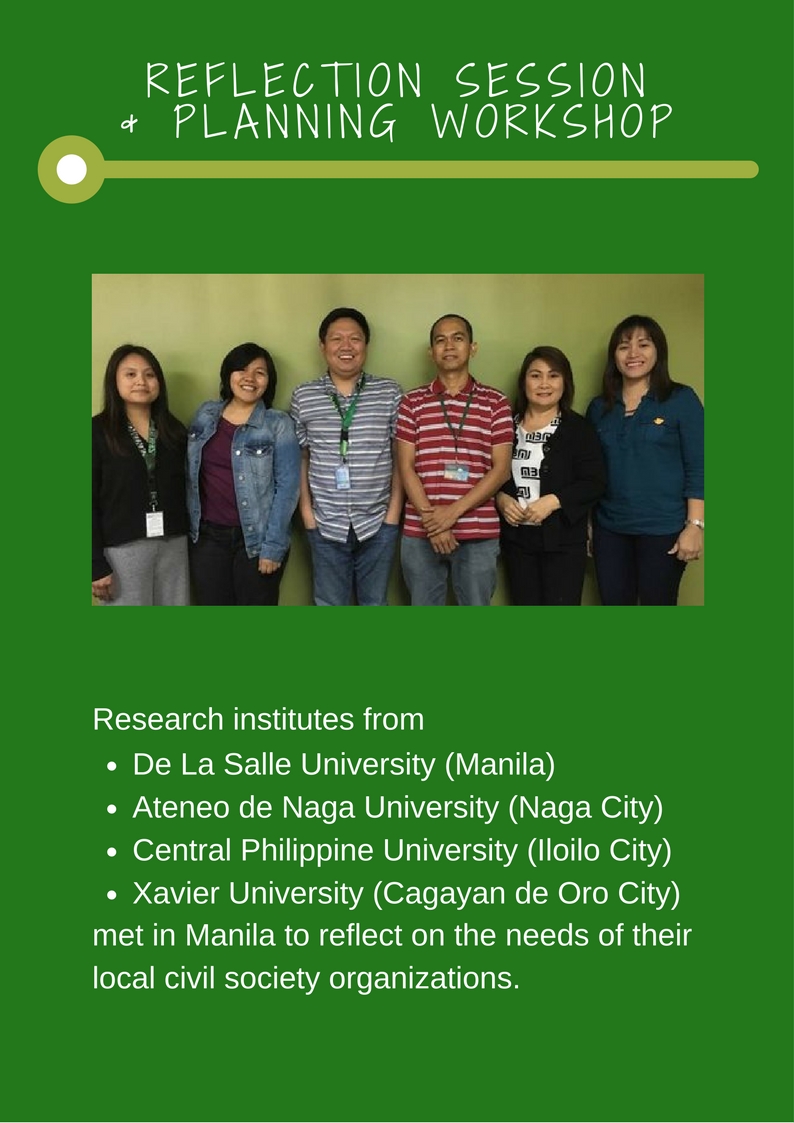
With the support of Hivos, Global Integrity, and the Institute of Development Studies, this action research capacitated regional university-based research centers to help local stakeholders in using open local government data. The Institute partnered with three (3) local research centers based in regional universities: Center for Local Governance (CLG) of Ateneo de Naga University; the Center for Local Governance and Indigenous People’s Studies (CLGIPS) of Central Philippine University; and the Governance and Leadership Institute (GLI) of Xavier University. The knowledge partnership between JMRIG and the regional universities resulted in the production of tools and technologies that facilitate citizen use of open government data. In particular, the project produced the following outputs: online and offline knowledge portals on open government data and social accountability that can be accessed by citizens; city budget infographics and budget analysis based on publicly disclosed data that can be used by CSOs and local government units to improve local planning and budgeting; and a compendium of local social accountability tools that can be accessed by citizens for capacity development. Through the knowledge partnership, research centers in the regional universities gained knowledge and skills on using information, particularly publicly disclosed open government data. The initiative also contributed to the development of new local knowledge partnerships between regional universities, civil society organizations and local government units. [Click here][0] to learn more about the project and to visit our open government portal.
-
This project was implemented in partnership with the Transparency and Accountability Network. The project trained community members and organizations on the principles, processes, and guides to community participation in procurement. We worked with stakeholders such as People’s Organizations, Non-Government Organizations, community leaders, local government officials and officers, volunteers, and those that are already involved in the implementation of projects in the local government unit (LGU). For example, we worked with KALAHI-CIDSS, a community-driven development project implemented by the Department of Social Welfare and Development (DSWD). Under KALAHI-CIDSS, communities and their Local Government Units (LGUs) are trained to choose, design and implement sub-projects that address their most pressing need.
-
With the support of the International Budget Partnership (IBP) at the Center on Budget and Policy Priorities in Washington, D.C., the project developed a training program on the basics of local budget literacy. This training program was available to IBP partners, particularly the Concerned Citizens of Abra for Good Government and Balay Mindanaw Foundation, Inc. The training focused on enhancing local CSO capacity to use and analyze LGU budget documents. We engaged in this project because we believe that public service delivery can improve when CSOs are engaged in budget processes and policies.
-
This project was undertaken in partnership with the Caucus of Development NGO Networks (CODE-NGO), Philippine Partnership for the Development of Human Resources in Rural Areas (PhilDHRRA), and the Transparency and Accountability Network (TAN). The assessment of the 2010 Performance Challenge Fund (PCF) Program and 2011 Seal of Good Housekeeping (SGH) Program of the Department of the Interior and Local Government (DILG) of the Philippines was prepared with the support of the World Bank and AusAID through the AusAID-World Bank Development Trust Fund. An evaluation was made on the implementation of LGU sub-projects financed through the 2010 PCF Program and an evaluation of the incentive effects of the 2011 PCF and SGH Program implemented nationwide.
-
With the support of AusAID, we facilitated discussions among multiple stakeholders in ten research areas. The Philippine Local Governance Transparency and Accountability Indicators is a list of 175 indicators with scoring criteria covering several types of mechanisms such as the following: accessibility to information, proactive disclosure of information, citizen participation, local elections, internal checks and balance, rule-based procedures, and external oversight institutions. We used this framework to conduct participatory workshops in order to plan strategies for improving transparency and accountability and developed a toolkit on performing transparency and accountability assessments.
-
In partnership with Global Integrity from Washington, D.C., we developed the capacity of local stakeholders to undertake evidence-based reforms. We established a set of indicators to measure the existence, effectiveness, and accessibility of key transparency and accountability mechanisms in local governance. The indicators were then used to assess transparency and accountability mechanisms in ten cities and municipalities throughout the country.
-
Funded by the Institutional Development Fund of the World Bank, this three-year project enhanced the capacity of civil society organizations (CSOs) and government agencies to collectively monitor and evaluate local public service delivery. We developed knowledge partnerships with the following local universities: St. Paul Philippines, Bicol University, Silliman University, University of San Carlos, Central Philippine University and Mindanao State University. Through this project, we were able to establish local multi-stakeholder knowledge partnerships in eight municipalities and develop the capacity of our local knowledge partners.
-
This project was supported by the United States Agency for International Development (USAID). Through this project, we trained civil society leaders to systematically monitor the national budget from budget formulation to execution. We engaged with the International Center for Innovation, Transformation, and Excellence in Governance (InciteGov) and Management Systems International (MSI) to implement a series of training seminars.
-
A series of training seminars for poll watchers on Vote Protection was conducted from March to April 2007 in key cities, including San Fernando (La Union), Lucena, Naga, Iloilo and Cagayan de Oro. A handbook on poll watching based on the Commission on Elections 2007 General Instructions was produced and used in the program with the support of the Friedrich Naumann Foundation.
-
The objective of the project was to develop information and communications technology (ICT) applications that will benefit rural communities. The Institute collaborated with the Blekinge Institute of Technology, Sweden and the Directorate for ICT support at Makerere University, Uganda, with the support of the Swedish ICT for Developing Regions (SPIDER) Programme. The Agricultural Portal for the municipality of Imus, Cavite was a key application produced under the project.
-
With a sub-grant from the Transparent Accountable Governance Project of the Asia Foundation, we provided technical assistance to the Northern Luzon Coalition for Good Governance in strengthening its organizational structure in 2007. This project also enabled the Coalition to develop corruption monitoring and prevention plans by studying local planning, budget, procurement, and expenditure tracking.
-
Following a competitive bid, our Institute was chosen to provide technical assistance to the Philippine Congress under the Governance Portfolio of the United Nations Development Programme (UNDP). We were developed a customized knowledge and skills training program on legislative strengthening for the Secretariat of the House of Representatives led by the Congressional Planning and Budget Office (CPBO). After performing a training needs analysis, we conducted focus group discussions and key informant interviews with directors and senior officials of the various congressional units. Modules on social and knowledge networking, governance and state building, legislative management, economic competitiveness, and industry analysis were the key outputs of the project.
OUR SPONSORS
Support for this project was provided by:


